
A professional spa facial is one of the most effective ways to deeply cleanse, exfoliate, and revitalize your skin. However, maximizing the results of your investment requires proper prep. What you do in the days leading up to your appointment directly impacts how well your skin absorbs treatment products and tolerates extractions or chemical exfoliants.
Proper preparation protects your skin barrier, prevents post-facial irritation, and gives your esthetician a clear, stable canvas to work on.
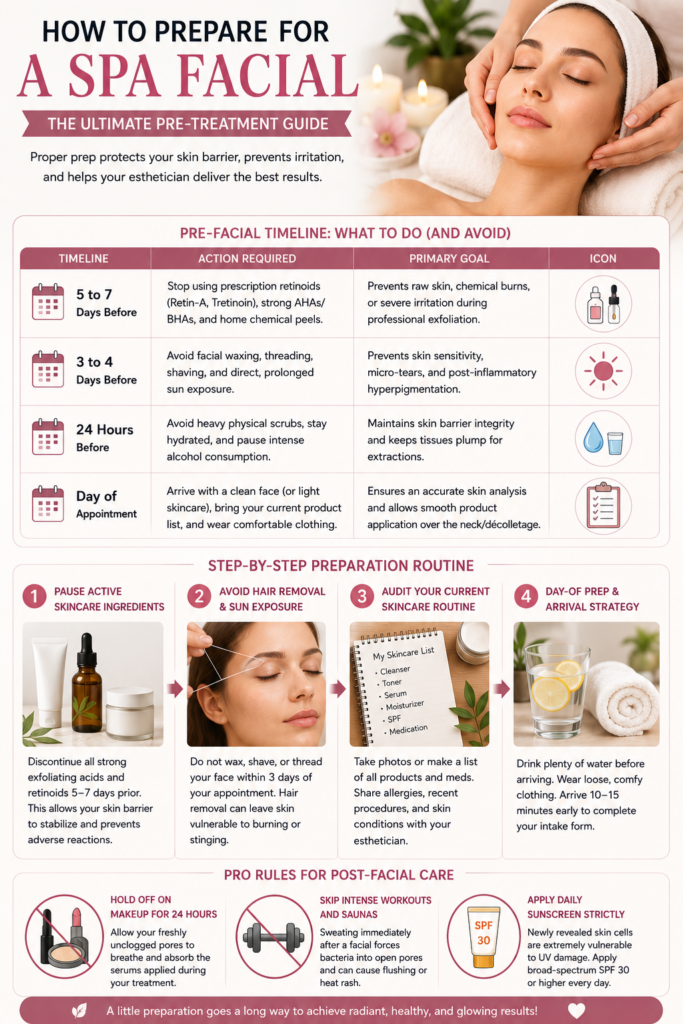
Pre-Facial Timeline: What to Do (and Avoid)
Preparing for a facial is a stepped process. Stopping harsh active ingredients in advance allows your skin moisture barrier to recover before professional treatment:
| Timeline | Action Required | Primary Goal |
| 5 to 7 Days Before | Stop using prescription retinoids (Retin-A, Tretinoin), strong AHAs/BHAs, and home chemical peels. | Prevents raw skin, chemical burns, or severe irritation during professional exfoliation. |
| 3 to 4 Days Before | Avoid facial waxing, threading, shaving, and direct, prolonged sun exposure. | Prevents skin sensitivity, micro-tears, and post-inflammatory hyperpigmentation. |
| 24 Hours Before | Avoid heavy physical scrubs, stay hydrated, and pause intense alcohol consumption. | Maintains skin barrier integrity and keeps tissues plump for extractions. |
| Day of Appointment | Arrive with a clean face (or light skincare), bring your current product list, and wear comfortable clothing. | Ensures an accurate skin analysis and allows smooth product application over the neck/décolletage. |
Step-by-Step Preparation Routine
- Pause Active Skincare Ingredients:
Avoids over-exfoliation and skin barrier compromise.
Discontinue all strong exfoliating acids (glycolic, lactic, salicylic) and retinoids 5–7 days prior. Allowing your skin’s natural lipid barrier to stabilize prevents adverse reactions when professional-grade enzymes or acids are applied.
- Avoid Hair Removal & Sun Exposure:
Prevents increased sensitivity and vascular dilation.
Do not wax, shave, or thread your face within 3 days of your appointment. Hair removal strips the top layer of skin cells, leaving the area vulnerable to burning or stinging during steam and deep cleansing steps.
3. Audit Your Current Skincare Routine:
Helps your esthetician tailor a safe, customized regimen.
Take photos or make a list of all products, serums, and medications you currently use. Be ready to share details about allergies, recent cosmetic procedures (like Botox or fillers), and underlying skin conditions.
4. Day-of Prep & Arrival Strategy:
Ensures maximum comfort and efficient treatment time.
Drink plenty of water before arriving to keep skin cells hydrated. Wear loose, comfortable clothing or an easy-to-remove top, as facials often include massage across the neck, shoulders, and chest. Arrive 10–15 minutes early to complete your intake form without rushing.
Pro Rules for Post-Facial Care
- Hold off on makeup for 24 hours: Allow your freshly unclogged pores to breathe and absorb the nutrient-dense serums applied during your treatment without trapping new cosmetics.
- Skip intense workouts and saunas: Sweating immediately after a facial forces bacteria back into open pores and causes flushing or heat rash on sensitive, freshly exfoliated skin.
- Apply daily sunscreen strictly: Newly revealed skin cells are extremely vulnerable to UV damage. Apply a broad-spectrum SPF 30 or higher before stepping outside.