
Ingrown hairs are a frustrating, painful byproduct of hair removal. Whether they show up as small red bumps after shaving, itchy patches following a wax, or deep, swollen cyst-like spots along delicate areas, ingrowns happen when a hair curl or sharp follicle tip bends backward and grows re-entry-style into the surrounding skin.
Because your immune system treats the trapped hair shaft as a foreign object, the body responds with localized inflammation, redness, and swelling. Treating ingrown hairs successfully requires a delicate balance: calming active irritation without digging or picking at the skin, which can lead to permanent scarring or bacterial infection.
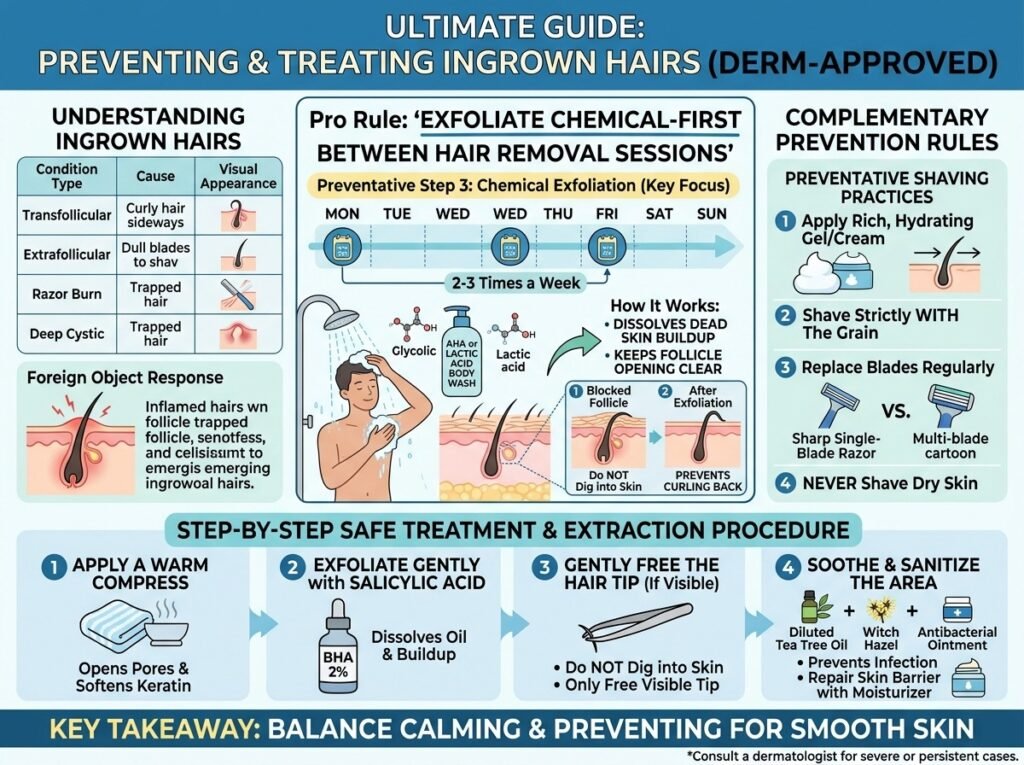
What Causes Ingrown Hairs? (And How to Identify Them)
Ingrown hairs present differently depending on your hair texture, skin type, and hair removal method:
| Condition Type | Underlying Cause | Visual Appearance | Best Initial Treatment |
| Transfollicular Penetration | Curly or coarse hair growing sideways, piercing the follicle wall | Small, red raised bump with a visible hair loop under the surface | Warm compress + gentle BHA (salicylic acid) exfoliation |
| Extrafollicular Penetration | Hair cut short with sharp edges that curves back and pierces nearby skin | Tender, pus-filled bump (pseudofolliculitis) resembling a pimple | Warm compress + spot treatment with tea tree or hydrocortisone |
| Razor Burn / Friction | Dull razor blades stripping the lipid barrier and dragging hair back | Broad cluster of tiny red, burning bumps | Cool compress + aloe vera or centella soothing gel |
| Deep Cystic Ingrown | Trapped hair trapped beneath thick layers of dead skin cells | Large, firm, painful lump deep beneath the skin without a visible hair | Warm compress + ammonium lactate / glycolic acid (Do NOT squeeze) |
Step-by-Step Safe Treatment & Extraction Procedure
1.Apply a Warm Compress:Opens skin pores and softens hardened keratin around the trapped hair.
Soak a clean washcloth in warm (not hot) water and press it firmly against the affected area for 5 to 10 minutes. The moist heat softens the top stratum corneum layer and increases blood flow to reduce localized swelling.
2.Exfoliate Gently with Salicylic Acid:Dissolves oil and dead skin cells holding the hair beneath the surface.
Apply a leave-on 2% salicylic acid (BHA) lotion or serum over the bump. Salicylic acid is oil-soluble, allowing it to penetrate deep inside the pore lining to dissolve dead skin buildup without harsh physical scrubbing.
3.Gently Free the Hair Tip (If Visible):Only perform if the hair loop is clearly visible above the skin surface.
If a loop or tip of the hair is clearly visible above the skin, sanitize a pair of fine-tipped tweezers with alcohol. Do not dig into the skin. Gently hook the visible hair loop and lift the tip out. Leave the root inside the follicle so it heals naturally.
4.Soothe & Sanitize the Area:Prevents secondary bacterial infection and dark spot formation.
Dab a small drop of diluted tea tree oil, witch hazel, or an antibacterial ointment over the freed pore. Follow up with a lightweight, non-comedogenic moisturizer to repair the skin barrier.
Pro Rules to Prevent Future Ingrown Hairs
- Never shave on dry skin or against the grain: Always apply a rich, hydrating shaving gel or cream, and shave strictly in the direction of hair growth. Shaving against the grain cuts the hair shaft too close beneath the follicle opening, encouraging re-entry.
- Replace razor blades regularly: Multi-blade or dull razors tug and pull at hair shafts before cutting them, leaving sharp, angled tips. Switch to a sharp single-blade or safety razor every 5 to 7 shaves.
- Exfoliate chemical-first between hair removal sessions: Incorporate a gentle glycolic acid (AHA) or lactic acid body wash 2 to 3 times a week. Keeping the skin surface clear of dead cell accumulation prevents emerging hair tips from getting blocked.
If you wax regularly, follow our post-wax ingrown hair prevention routine; for a longer-term solution, ask about laser hair removal in Luton.
Explore more beauty guides: Waxing & Hair Removal