
Facial hair is completely natural, fine vellus hair (“peach fuzz”) protects delicate facial skin and helps regulate body temperature. However, whether for smoother makeup application, skincare product absorption, or personal preference, deciding to remove facial hair requires choosing a method that respects your skin barrier.
Because facial skin is thinner and far more sensitive than the rest of the body, improper removal techniques easily cause breakouts, hyperpigmentation, or severe irritation.
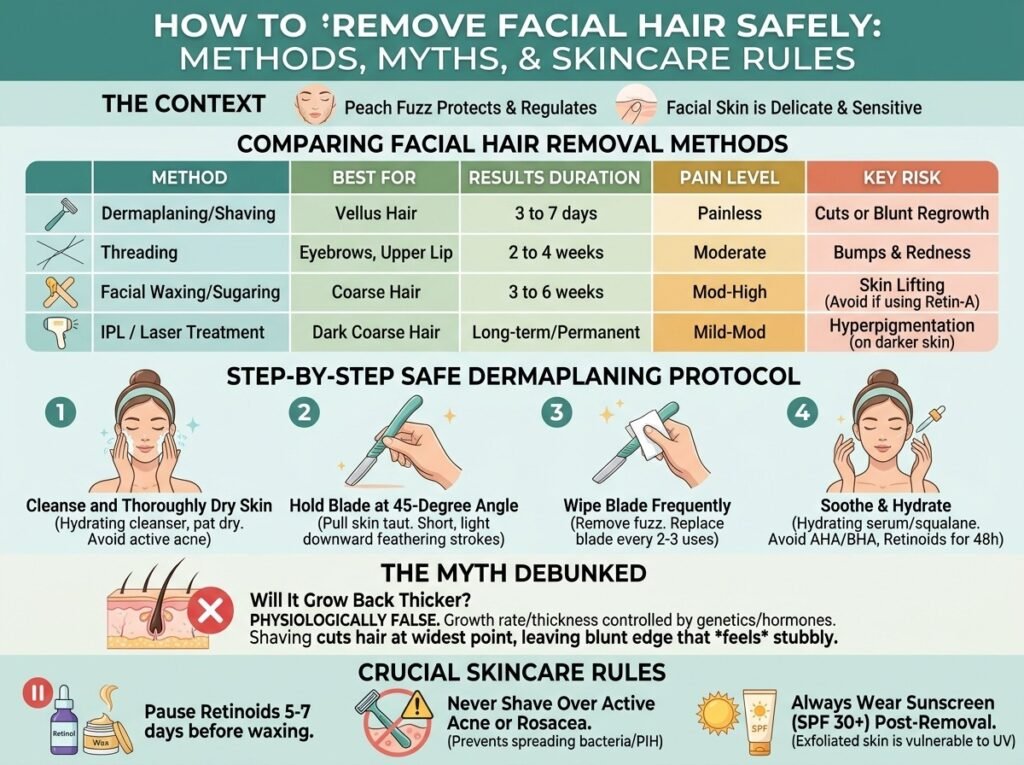
Comparing Facial Hair Removal Methods
Choosing the right technique depends on your hair type (vellus vs. terminal/coarse hair), pain tolerance, budget, and skin sensitivity:
| Method | Best Hair Type | Results Duration | Pain Level | Key Skincare Risk |
| Dermaplaning / Shaving | Fine vellus hair (peach fuzz) | 3 to 7 days | Painless | Micro-cuts or blunt regrowth texture |
| Threading | Eyebrows & upper lip (coarse/fine) | 2 to 4 weeks | Moderate | Temporary redness & follicle bump irritation |
| Facial Waxing / Sugaring | Coarse upper lip & chin hair | 3 to 6 weeks | Moderate-High | Skin lifting (especially with Retin-A users) |
| Facial Epilators | Sparse chin or cheek hairs | 3 to 4 weeks | Moderate-High | Ingrown hairs if pulled incorrectly |
| IPL / Laser Treatment | Dark coarse terminal hair | Long-term / Permanent | Mild-Moderate | Hyperpigmentation on darker skin tones |
Step-by-Step Safe Dermaplaning Protocol
Dermaplaning uses a specialized single-blade tool held at an angle to skim away fine vellus hair and dead skin cells simultaneously.
- Cleanse and Thoroughly Dry the Skin:
Removes surface oils, makeup, and bacteria before blading.
Wash your face with a gentle, hydrating cleanser and pat it completely dry. Never dermaplane on dirty skin, active acne, or open skin lesions, as moving a blade across bacteria spreads infection across open pores.
2. Hold the Blade at a 45-Degree Angle:
Holds skin taut to prevent the blade from catching or cutting.
Pull a section of skin tight with one hand. Hold the dermaplaning blade in the other hand at a 45-degree angle against the skin. Use short, light, downward feathering strokes in the direction of hair growth.
3. Wipe the Blade Frequently:
Prevents dull blades from tugging skin and causing razor burn.
After every few strokes, wipe accumulated peach fuzz and dead skin cells off the blade using a clean tissue or alcohol swab. Never use a dull dermaplaning blade more than 2 to 3 times before replacing it.
4. Soothe & Hydrate (No Actives):
Replenishes moisture and reinforces the compromised skin barrier.
Rinse your face with lukewarm water and apply a soothing, barrier-repairing serum containing squalane, hyaluronic acid, or ceramides. Avoid exfoliant acids (AHAs/BHAs) and retinoids for 48 hours.
The Debunked Myth: “Will It Grow Back Thicker?”
The persistent belief that shaving or dermaplaning facial hair causes it to grow back darker, thicker, or faster is physiologically false.
Hair growth rate, thickness, and color are entirely controlled by internal genetics and hormone levels (such as androgens). When you cut or shave a hair strand at the skin surface, you cut through the shaft at its widest point. As it emerges, the blunt edge feels temporarily stubbly or coarse to the touch—but the follicle structure itself remains completely unchanged.
Crucial Skincare Rules for Facial Hair Removal
- Pause retinoids before waxing or sugaring: Stop using topical prescription retinoids (Tretinoin, Adapalene) or strong AHA/BHA exfoliants at least 5 to 7 days before waxing. Retinoids thin the outer skin layer, causing hot wax to rip off live epidermal skin cells along with the hair.
- Never shave over active acne or rosacea: Passing a blade over raised breakouts or inflamed rosacea cuts the lesions open, introducing bacteria deeper into the dermis and leaving post-inflammatory hyperpigmentation (dark spots).
- Always wear sunscreen post-removal: Freshly hair-free, exfoliated skin is extremely vulnerable to UV damage. Always finish your morning routine with a broad-spectrum SPF 30 or higher to prevent dark spots and sun sensitivity.