
Cutting men’s hair at home—whether maintaining a crisp crew cut, blending a classic taper, or trimming a scissor-cut classic—comes down to understanding structured blending. Barbering relies on the rule of working from bottom to top, using guard lengths to seamlessly transition short sides into longer top hair without creating harsh lines or stair-steps.
The difference between a polished haircut and a noticeable home DIY job isn’t expensive equipment; it’s mastering the “C-scoop” motion with clippers and maintaining consistent finger tension with shear work.
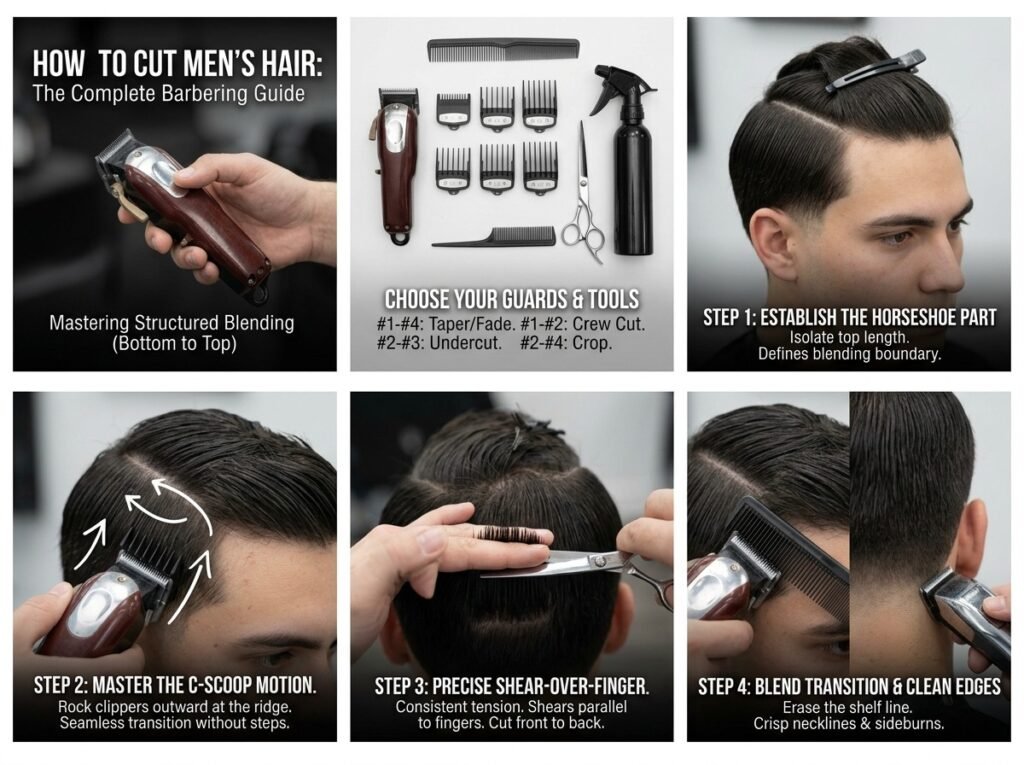
Choosing the Right Guard System & Technique
Before powering on your clippers, match your desired style to the right guard sizes and cutting tool combo:
| Haircut Style | Side & Back Guards | Top Technique | Blending Difficulty |
| Classic Taper / Fade | #1 (1/8″) to #4 (1/2″) | Shear over finger / scissor-cut | Medium (Requires careful guard blending) |
| Crew Cut / Buzz Cut | #1 (1/8″) or #2 (1/4″) | #5 (5/8″) or #6 (3/4″) guard | Low (Great for complete beginners) |
| Modern Undercut | #2 (1/4″) or #3 (3/8″) | Disconnected long top (shear cut) | Low-Medium (Minimal blending required) |
| Textured Crop / Quiff | #2 (1/4″) to #4 (1/2″) | Point-cut with shears + texturizing | High (Requires precision shear work) |
Step-by-Step Men’s Haircut Procedure
- Prep Hair & Establish the Horseshoe Part:
Clears bulk and sets the highest guard length along the parietal ridge. Dampen the hair slightly for scissor work, or keep it completely dry for clippers. Comb the hair downward along the sides and back, and isolate the longer top hair by combing it into a “horseshoe” parting around the crown and parietal ridge (where the head curves inward).
2. Clip the Sides & Back with the C-Scoop Motion:
Creates a smooth transition line without cutting harsh steps into the head shape. Attach your longest chosen guard (e.g., #4) and run the clippers straight up the sides, flicking the wrist outward in a “C-scoop” motion as you hit the parietal ridge. Switch to smaller guards (#3, then #2) as you move lower down the head, always scooping outward to blend each guard line seamlessly into the next.
3. Trim the Top Using Shears over Fingers:
Controls length and establishes weight distribution across the head. Unclip the top section. Pull 1/2-inch sub-sections straight up between your index and middle fingers at a 90-degree angle from the scalp. Cut across horizontally, working from the front hairline backward toward the crown. Use a small piece of your first cut section as a guide length for every subsequent pass.
4. Blend the Transition Zone & Edges:
Eliminates the shelf line between clipped sides and scissor-cut top. Use the clipper-over-comb method or point-cut vertically into the transition boundary where the short sides meet the longer top. Next, remove all guards and use the open blade of your clipper or a detail trimmer to clean up the neckline, sideburns, and behind the ears for a crisp, professional finish.
Barber Rules for Home Haircutting Success
- Work with the open/close lever: Modern clippers have a side taper lever. An “open” lever (pushed down) adds half a guard length, allowing you to erase stubborn blend lines between guard sizes (e.g., bridging a #2 open to a #3 closed).
- Never rush the neckline: A natural, soft-tapered or square-blocked neckline defines the entire haircut. Keep the client’s head tilted slightly forward while cleaning the neck to avoid uneven lines when they look back up.
- Keep shears parallel to fingers: When trimming the top, keep your cutting shears flat against your fingers. Tilting shears at an angle causes uneven valleys across the top profile.