
Hair removal creams (technically known as depilatories) offer a quick, painless alternative to shaving, waxing, and epilating. Unlike shaving—which chops hair off at a sharp angle at the skin surface—or waxing—which forcibly pulls hair out from the root—depilatory creams rely on a controlled chemical reaction to dissolve the hair structure just below the skin’s surface.
Understanding how depilatories work under the skin helps you achieve smooth results, avoid chemical burns, and protect your skin barrier.
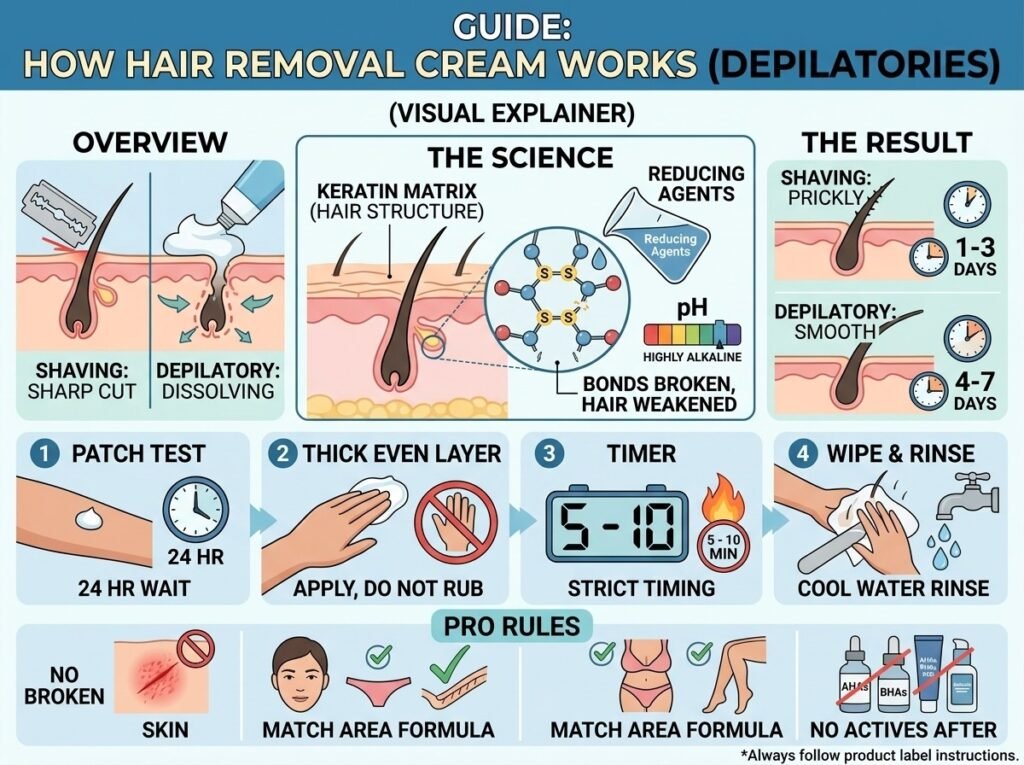
The Science: Breaking Down the Keratin Matrix
Hair strands are primarily composed of keratin, a dense, fibrous protein held together by strong chemical bonds—specifically disulfide bonds. These sulfur-to-sulfur links give human hair its structural strength, elasticity, and shape.
Depilatory creams work by combining strong alkaline compounds with specific reducing agents to break those chemical bonds apart:
| Chemical Component | Active Ingredient Example | Primary Role in Hair Removal |
| Reducing Agents | Potassium thioglycolate or Calcium thioglycolate | Cleaves and breaks open the disulfide bonds in the hair’s keratin structure. |
| Alkaline pH Boosters | Calcium hydroxide or Sodium hydroxide | Raises the cream’s pH level (typically to 11–12), swelling the hair shaft so chemicals penetrate quickly. |
| Soothe & Guard Emollients | Aloe vera, mineral oils, or shea butter | Cushions the skin lipid barrier to offset irritation caused by the high pH level. |
Once these active chemicals penetrate the hair shaft, the keratin matrix breaks down into a soft, jelly-like consistency. When you wipe the cream away after a few minutes, the weakened hair strand shears off effortlessly right at or slightly beneath the skin opening.
Depilatories vs. Shaving vs. Waxing
| Feature | Depilatory Creams | Traditional Shaving | Waxing / Sugaring |
| Mechanism | Chemical breakdown of keratin bonds | Mechanical blade slice at skin level | Epilation (pulls hair root out from follicle) |
| Hair Tip Texture | Softened, rounded tip (less stubbly regrowth) | Sharp, blunt angle (feels rough and pricklier) | Fine, tapered new hair growth |
| Results Duration | 4 to 7 days | 1 to 3 days | 3 to 6 weeks |
| Ingrown Hair Risk | Low (No sharp cut edge) | High (Sharp tips re-enter skin easily) | Moderate (Breakage during pull causes ingrowns) |
If you’re switching to waxing, our guide to reducing waxing pain will help you through your first appointment.
Step-by-Step Safe Application Protocol
- Perform a 24-Hour Patch Test:
Prevents widespread allergic reactions or chemical sensitivity.
Apply a nickel-sized dab of cream onto a small, discreet patch of skin (like your inner forearm or lower leg). Leave it on for the maximum recommended time on the label, rinse off thoroughly, and wait 24 hours to check for redness, itching, or swelling.
- Apply a Thick, Even Layer (Do Not Rub In):
Ensures equal chemical contact across all hair shafts.
Smooth a generous, uniform layer of cream over dry skin, completely coating the hair strands down to the roots. Do not rub the cream into your skin as you would a lotion; keeping it sitting on top minimizes deep dermal absorption.
- Time the Session Strictly (5–10 Minutes):
Prevents severe chemical burns from over-exposure.
Set a timer immediately. Never guess the elapsed time. Most formulas require 5 to 10 minutes maximum to break down keratin. If you feel intense stinging or burning before the timer goes off, wipe it off and rinse immediately.
- Wipe Away & Rinse with Cool Water:
Restores natural skin pH and removes chemical residue.
Use a damp washcloth or the provided plastic spatula to gently scrape away a small test area. If hair slides off easily, wipe the remaining cream away in sweeping upward strokes. Rinse the area thoroughly with cool or lukewarm water—do not use harsh soap—and pat dry.
Pro Rules for Chemical Hair Removal Success
- Never use on broken, sunburned, or freshly shaved skin: The high pH (11–12) of depilatory creams will cause intense chemical stinging and potential chemical burns on open micro-wounds or compromised skin barriers.
- Match the formula to the target body area: Facial skin and bikini areas are significantly thinner and more sensitive than legs or arms. Always use a formula explicitly labeled for sensitive zones or facial hair.
- Avoid active skincare ingredients post-removal: Do not apply AHAs, BHAs, retinoids, alcohol-based toners, or scented body lotions to the treated area for at least 24 to 48 hours after using hair removal cream.
Any method that removes hair at the surface can lead to ingrowns, so keep our ingrown hair treatment and prevention guide handy.
Explore more beauty guides: Waxing & Hair Removal