
Massage therapy isn’t just a spa-day luxury; it is a vital tool for physical maintenance, mental decompression, and chronic pain management. However, booking a session once a year won’t yield long-term health benefits.
The ideal frequency for getting a massage depends entirely on your lifestyle, physical demands, and specific health goals. Whether you are recovering from marathon training, managing a stiff lower back, or simply trying to survive a high-stress career, tailoring your massage schedule ensures you get the maximum therapeutic return on your investment.
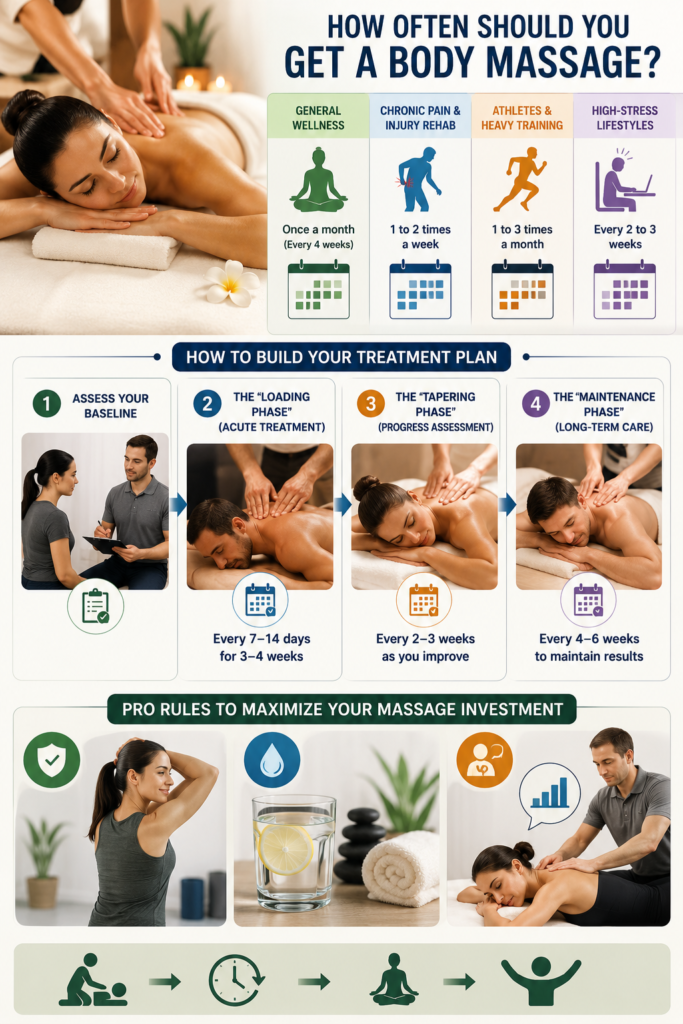
Determining Your Ideal Massage Frequency
There is no universal “right” amount of massages, but physical therapists and massage professionals generally categorize frequency based on primary goals:
| Your Primary Goal | Recommended Frequency | Why This Works |
| General Wellness & Relaxation | Once a month (Every 4 weeks) | Maintains basic muscle elasticity, keeps stress hormones (cortisol) in check, and prevents minor tension from building into pain. |
| Chronic Pain & Injury Rehab | 1 to 2 times a week | Rapidly breaks down rigid fascial adhesions and scar tissue. Once mobility improves, frequency tapers down. |
| Athletes & Heavy Training | 1 to 3 times a month | Flushes metabolic waste (lactic acid) from heavy lifting or endurance cardio, preventing micro-tears from becoming major injuries. |
| High-Stress Lifestyles | Every 2 to 3 weeks | Combats the physical manifestations of stress—like a clenched jaw, tight neck, and raised shoulders—before they cause tension headaches. |
Step-by-Step: How to Build Your Treatment Plan
If you are dealing with a specific issue, jumping straight to a “once-a-month” schedule might not fix the root cause. Follow this clinical approach to building a schedule:
- Assess Your Baseline & Book an Evaluation:
Identifies the root cause of muscular dysfunction. During your first session, explicitly state your goals to the therapist (e.g., “I sit at a desk for 10 hours a day and have severe neck pain”). They will assess your posture, muscle density, and range of motion to determine how much work is required.
2. The ‘Loading Phase’ (Acute Treatment):
Breaks the cycle of chronic pain and muscle guarding. If you have chronic pain or a fresh injury, start with intensive therapy. Book a session every 7 to 14 days for the first 3 to 4 weeks. Frequent visits prevent the muscles from snapping back into their familiar, tightened state between sessions.
- The ‘Tapering Phase’ (Progress Assessment):
Tests the tissue’s ability to hold the newly relaxed state. As your pain decreases and flexibility increases, gradually stretch the time between appointments to every 2 or 3 weeks. If the pain returns, the gap is too long; if you feel fine, you are ready for the next phase.
4. The ‘Maintenance Phase’ (Long-Term Care):
Prevents regression and maintains optimal tissue health. Once your acute issue is resolved, shift to a preventative schedule of one massage every 4 to 6 weeks. Combine this with daily at-home stretching, foam rolling, and adequate hydration to extend the benefits of the clinical work.
Pro Rules to Maximize Your Massage Investment
- Don’t wait until you’re in agony: Think of massage like dental cleanings—it is preventative maintenance. If you wait until you can’t turn your neck to book an appointment, it will take multiple painful sessions to undo the damage.
- Hydration dictates recovery: Deep tissue manipulation pushes fluid and metabolic waste out of the muscle belly. If you do not drink plenty of water post-massage, that waste stagnates, leading to severe soreness the next day.
- Be vocal during the session: Your therapist cannot feel what you feel. If the pressure is causing you to tense up or hold your breath, it is counterproductive. Always speak up to adjust the intensity.